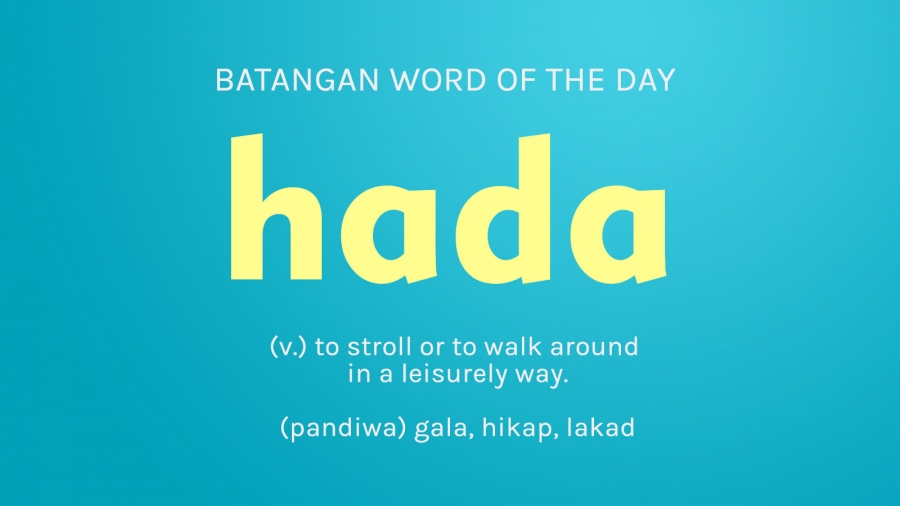
Hada and Other Confusions: Batangan Tagalog
“Hahada laang.”
This was what I told my new housemates in UP Diliman when they asked me where I was going. They laughed their guts out. I didn’t know why. But I laughed with them. Pretended I was getting the joke I didn’t even realize I cracked.
I added, “Bakit? Gusto nyo sumama?”
And they laughed even harder. Way harder. I was a college freshman, promdi in the city.
“Hada” in Batangas, or at least in Lemery, means “to take a walk.” Hihikap. Gagala. Maglalakad-lakad. It took me almost two years to finally figure out that “hada” in gay lingo actually means blow job. I didn’t know.
When I tell people I’m a Batangueno, their first reaction is always, “How come you don’t have the accent?” I never had that accent. I can fake it but I never had it. We don’t have it in the family because it was our dad, who was from Masbate, who stayed with us at home growing up. But fellow Batanguenos and even those who hailed from other Southern Tagalog provinces easily trace my Batangan roots when I start talking. I may not have the accent, but my diction — ah, my diction — is as Batangan as it can get.
Most of the time, I have no idea that the Tagalog words I utter are words that only Batanguenos comprehend. That’s the difficulty with dialects. With a different language (Ilokano, Cebuano, Bikolano), you are certain that the words you say will not be understood by those in the capital. Dialects are trickier. It was just so hard to tell whether the words I was about to utter were words they would understand or not.
No wonder a friend in college still had his big toe injured when I told him “may purunggo sa sahig.” Or that my roommate then didn’t get me anything when I told him to buy sinturis on his way home. Or that he continued eating the bar of snickers I left on the table even after I warned him “ginuguyam na yan.” Or that my colleague thought I was pissed at her when I said “nababanas ako.” Or that they thought I could not taste anything when I told my friends “masama ang pakilasa ko.”
Or why they would give me a what-the-heck look every time I said “labis ng piso yung sukli.” Naiintindihan naman daw nila yung labis pero “sobra” raw yung madalas gamitin. Sabi nila, sa pag-ibig lang daw ‘yun ginagamit. O kaya sa pag-asa. O pag-aalala. Weh? Sinong may sabi? Iharap n’yo sa akin. Kainaman.
Since then, I had a certain reputation. The one who always asks if they know a certain Tagalog word. (I’m afraid they would not understand.) Or the one who speaks 10,000BC Tagalog. Or the one who says “buksi*” rather than “buksan mo” or “sarahi” rather than “isara mo.” Or simply the guy na nahada kapag gab-i.
But I’m not complaining. Somehow, it gives me character. And it’s a character that I’ve always been grateful for and will always be proud of.
————————
GLOSSARY
hikap (v) maglakad-lakad
purunggo (n) bubog
sinturis (n) dalandan
guyam (n) langgam
nababanas (v) naiinitan
pakilasa (n) pakiramdam
NOTE. *An undeniable character of the Batangan Tagalog is the use of the verb ending ‘-i’ instead of ‘-na’, especially in the command form. This only happens when the verb stands alone in a sentence or when the verb is the last word in the phrase. –Wikipedia
i think its very charming! hehe
thank you for that. haha.
Same with the Japanese language. I have a friend from Osaka and sometimes she utters weird Japanese terms that Tokyoites couldn’t understand.
But while on languages, let me put on an observation about languages here in the Philippines. Like why do people here call Cebuano and non-Tagalog languages “dialects”?
Dialects are variants of a language. Tagalog is the language while Batangan, Tayabasin and the standardized “Filipino” are its dialects. Same with British English and American English, or, in Japan’s case, Kantoben and Kansaiben. They are mutually intelligible. Meaning, although there are words that are quite different, the dialect is generally understood by speakers of another dialect of the same languages.
Languages, on the other hand, are not mutually intelligible. They have distinct sets of grammar and vocabulary. Since speakers of Tagalog can’t understand Cebuano completely, Cebuano is not a mere “dialect” but a language in its own right.
I know this isn’t a big deal for many. But I get the feeling that calling non-Tagalog languages as mere”dialects” is an subconscious form discrimination against non-Tagalog Filipinos.
and, oh, Filipino is not a language. It’s a dialect of Tagalog. Tagalog IS the national language. 😀
alam mo, that’s exactly what ive been trying to explain to all my friends. hahaha.
– that Filipino is a dialect of Tagalog
– that Cebuano is not a dialect but a language
– and that dialects are different from languages
All these were emphasized din sa Sub-cultures class namin sa Ateneo. I was like, “See? I told you so.” Haha. Ang know-it-all ko talaga. Putcha.
copy!
Wow. Fast reply. It’s always good to know we agree, Yoshke. 😀
Kung si Berg ang ka-match ng taste ko sa music, parang ikaw sa political and social issues. Haha. Parang music source ko yang si Berg e, kasi most of the time, sa blog nya na lang ako nagda-download. Haha.
Kaya hindi rin ako masyado nagpo-post about politics and music e, kasi parang nasabi nyo na rin naman mga gusto kong sabihin. Hehehe
At sinisisi ko talaga kayo. :))
Mahilig ka pa lang humada pag gab-i
haha, if you mean “maglakad,” OO.
Ala, Yang purunggo ay ngay-on ko laang narineg.
Apir kabayan!
ahahahahha! ang ganda talaga pakinggan ang batangueno ano?
kakatuwa!
kakahiya lng… batanguena ako d man laang ako marunong… T_T
turuan nyo naman ako! ahahahahh!
@ jean…d mo dpat ikahiya kung wla ka púnto(accent), o wla ka alam na batangan tagalog…sapagkat ang pagiging batangueno dpat ay nsa puso, sa isip at sa asal…pero kung gusto mo matuto tlaga, d pa nman huli…one good tip? makipagkwentuhan ka sa mga matatandang batangan…
purbahan mo laang…at saan ka man sumuling, mapa-ibaba o mapa-ilaya ei pihadong ikaw ay may mapapala…
Hahaha. One of my fave Batanguenos. Miss you dear. *hug*
mabuhay mga batanguenos!!! woohoo!
hada. haha.
the. dream ko kaya yan. maging magaleng sa pagsalita at pagsulat both sa filipino at english.
hi am glad i come across your blog am batanguena too this reminds me of my college days in manila
” nakain ka ga ng isda” is my favorite nobody understand me back then and i didnt have any idea what i said wrong hehehe
hahaha. kaya minsan ang sarap makakilala ng iba pang batangueno!
one of my favorite posts yoshke. nakakarelate ako. taga mindoro ako at halos pareho tayo ng salita. andami ko ding ganyang moments nung college, minsan tuloy inuunahan ko ng tanungin kung tagalog ba ang isang word na sasabihin ko. alam ko lahat ng nabanggit mo, guyam, sinturis, pakilasa, pati yung gamit ng labis, etc. naaliw naman ako. i think mas mahirap intindihin yung sa mindoro sa gamit ng tense – nagaligo instead nagliligo, nagasulat – nagsusulat…plus our use of ngani, mandin in every sentence. nice post. 🙂
AKO RIN! inuunahan ko sila sa pagtatanong kung maiintindihan nila yung word na sasabihin ko.
Hindi ko alam na mejo pareho yung sa Mindoro. Sa Quezon, oo, alam ko. Pero no surprise, konting dagat lang mula samin, Mindoro na!
Batangan has some similarities with Ilonggo. Para din siyang Bisaya kung minsan. Observation ko lang yun ha.
I don’t know anything about Ilonggo. Hehe. So hindi ko macompare. Pero feeling ko, since magkakapatid lang naman ang mga languages natin, maraming similarities. 🙂
this just made my “what made you laugh today list.” nakaka-tuwa ang pagkakasulat. cecille and gravity introduced me to your blog. and i saw cecille’s comment here. i remember her pronouncing words with heavy accent way back in college. good thing though, she did quite a good job polishing that accent. 🙂
I though at first that you really were joking when you said “Hahada lang ako.” But it popped into my head, after you explained what you really meant with your speaking it, that you really wanted to take a walk. Some, although not a handful, still use that word in Lopez, a coastal town on the eastern part of Quezon province. Well, I didn’t really grow up there but my Mom was born and raised there and we had a lot of chances of spending our summer vacation in this very vast town (it had almost 100 barangays and its land area is more than half the size of the entire Metro). So just to share, I know a handful of Southern Tagalog words. 😀
Ala e kagaling nare.
I kind of had the same experience when I was a freshman at LB.
Natatawa mga kasama ko pag nagrereact ako ng “A-ah!” Hahaha Para daw lageng galit mga taga-Batangas. Tapos anlalakas pa magsalita! But comments like those just make me laugh and quite amused at myself, sabi mo nga may character, rich yung culture.
Ang galeng! hahaha Cool maging Batangueño! Hahaha I’m really proud! I really liked this post! Hope that through discussions about culture and language here in the Philippines may somehow break that regionalism attitude of Filipinos. Its good that we appreciate each other and laugh at ourselves. 🙂 Syang sya na e! Hahaha
nakakatuwa naman ang blog na are. ang about the “labis” part, i had an experience about that one too.. and all what i had to say was “ala,bahala kayo,pareho laang naman un..labis at sobra“haha
i like this one hehehe…. naalala ko tuloy batangas days ko! ang galing …
Hahaha….. nakakarelate ako dyaan. Nung una kong salta sa Maynila hindi ko maiwasang magsalita ng malalim na Tagalog.
Naalala ko tuloy yung mga words na nakain ako ng isda, nagpatak ang libro, paliwat liwat ng tubig, atbp.
I miss those days. i miss batangas. I miss san juan and laiya. ^^
Nung dumating ang mga Kastila sa Pilipinas, ang dialektong Batangan ang katugma ng sinaunang Tagalog na wala pang halong salitang Kapampangan, Ingles at Kastila. Base sa sensus na isinagawa ni Miguel de Loarca noong 1583, ang salita sa Tondo at Bulacan ay katulad ng salita sa Pampanga. Isinulat din ni Jose Villa Panganiban (Institute of National Language Commissioner) na ang guhit na naghahati sa pagitan ng Kapampangan at Tagalog ay ang Ilog Pasig. Ang salitang Tundo ay nagmula sa Kapampangang salita na ibig sabihin ay “inaantok” at maraming lugar sa Bulacan ngayon ang may pangalang Kapampangan. Kung iyong mapapansin ay may kahalintulad ang puntong Bulacan at Kapampangan na nagsasalita ng Tagalog. Malaki ang naging impluwensya ng lengguwaheng Sambal at Kapampangan sa pagbago ng sinaunang Tagalog ng Batangas sa mga lugar ng Aurora, Maynila, Bulacan, Bataan, Nueva Ecija, at Rizal.
Ang pinakaunang tulang Tagalog, ang karagatan at duplo ay nagmula sa Batangas. Ito ang nagsilang sa balagtasan noong panahon ng mga Amerikano. Sa katunayan noong 1925, sina Rosa Sevilla, Florentino Collantes (isang batikan ng ‘duplo’), José Corazón de Jesús at iba pang grupo ng mga manunulat ng Tagalog sa Maynila ay nagdesisyong palitan ang tradisyunal na duplo ng Batangas at pinangalanan itong ‘balagtasan’ para sa pagkilala kay Francisco Balagtas. Dito nagsimula ang pananaw ng mga taga-Maynila sa tunay na Tagalog dahil sa pagsulpot ng mga makata mula sa Gitnang Luzon.
Ang mga Kastila ang nagbago ng pagbigkas natin ng Tagalog, tulad ng pagbanggit nila sa mga salitang tamis at tanaw. Ang mga sinaunang Tagalog noon ang tawag sa mga ito ay tam-is at tan-aw, na kahalintulad ng pagbigkas ng mga Batanggenyo ngayon. Ang salitang Batanggenyo ay hindi isang dialekto, kundi isang orihinal na Tagalog na pinagmulan ng dialektong Marinduque, Bulacan at Maynila. Sa pagdaan ng panahon at naging moderno na ang Tagalog sa pagsanib ng salitang Ingles at Kastila at kalaunan ay naging Filipino sa pagsanib naman ng ibang lengguwahe mula sa ibang panig ng Pilipinas (halimbawa: tulad ng salitang ‘manong’), ang Batangan ay naging isang dialekto na laang.
Ang sinaunang Tagalog ay sinusulat gamit ang alpabetong Baybayin. Ang sistemang ito ay naiiba sa sistemang LCI dahil ito iyong panahon na hindi pa nabubuo ang Tagalog. Ang mga pagsulat ay binubuo lamang ng dalawang klase: P and KP (P=patinig, K=katinig), samantalang ang pagbigkas ay limitado sa P, KP, PK, at KPK. Ang salitang Tagalog ay walang kumpol na KKPK. Halimbawa, hindi akmang Tagalog noon ang ‘dyan’ at ang tamang pagbigkas dito ay ‘diyan’ na karaniwang binibigkas ng mga taga-Timog Katagalugan. Noong 1787, binanggit ng Kastilang si Gaspar de San Agustin na ang baybayin ng mga Tagalog ay sinusulat pa rin sa Batangas noong panahong karamihan sa mga ibang Tagalog ay hindi na ito ginagamit. Isang halimbawa ng mas sinaunang baybayin ng mga Tagalog ay natagpuan sa Calatagan.
Ang dialektong Tagalog sa Gitnang Luzon ay hindi malalim kundi ito ay mabulaklak laang. Naiintindihan karamihan ng mga taga-Timog Katagalugan ang dialektong Tagalog ng Gitnang Luzon pero bibihira sa kanila ang makaintindi sa mga Timog Katagalugan. Kung naging kabisera ng Pilipinas ang parteng Timog Katagalugan ay iba ang karaniwang Tagalog ng karamihan ngayon. Kung iyong mapapansin, matatagpuan ang Batangas sa kalagitnaan ng mga probinsyang Tagalog at nararapat na tawagin ang Timog Katagalugan na Gitnang Katagalugan imbes na Kamaynilaan dahil ang Metro Manila ay sentro ng lenggwaheng Filipino, hindi ng lumang Katagalugan.
References:
http://books.google.com.ph/books?id=PTIOAAAAIAAJ&printsec=frontcover&hl=en
http://ia331334.us.archive.org/1/items/thephilippineisl16501gut/16501-h/16501-h.htm
Maraming salamat. Mabuhay ka! Astig!
Ako’y labis na nagagalak pagka may gay-ang kwento ang Bantangueño. Palagi nating ipagmamalaki dahil tayo lamang ang sadyang makakapagbigay buhay sa bawat salita pagka ito’y binigkas na. Subukan nating ipasalita ang “ako’y hahada muna” ano man ang kahulugan nito…tanging tayo lamang ang makakapagsasabi nito nang may tunay na kahulugan at tamang bigkas at impit.
Sadyang kapuna puna, na pagka tayo ay gagayahin ng iba, kunwari ay sa mga palabas sa tilibisyon…sila ay tuong “trying hard”, ika nga sa ingles.
Pero kausapin mo ang genuine Batangueño at tunay na pagkasarap pakinggan.
Kaya naman ako’y tunay ding “Proud Batangueña”!
nakakatuwa nmn ang iyong blog yoshke. Naranasan ko din ang mga ganyang moments nung ako’y nagaaral p sa bataan, although parehong me kanya kanyang punto pero tulad mo din ako’y walang puntong batangas tulad ng karamihan..Hindi rin kaagad nila makuha ang ibig kong sabihin tulad ng “pasaan kayo?”akala nila marami sila pasa hahaha..at yang famous “nakain ka ng isda?” at yung..are, nare..etc..wala ako gaano punto pero minsa nakcarried away ako..slip of the tongue ba!hehehe
meron pala term sa amin taga-calatagan ako..yung “nakakaiyamot” meaning nakakainis..at yung lumang tagalog na “burat/naburat” which means butas/nabutas..hahaha
wala rin ako accent pero pag batangeño kausap ko talagang napapagaya ako. is pang mahirap intindihin ay apuyan at balatong. ha ha ha nice blog napatawa talaga ako. feel na feel ko
same with my experiences on my first year here in mla…
liliban – tatawid
papatak – mahuhulog, malalaglag
and so on..
You gotta love this one. After watching an episode of some drama that is supposed to be set in Batangas, they always start their sentence in ALA E. Locals all know that is not the case. Oh another word that baffles my friends were the words “barikan and silong”.
Enjoying reading your old blog entries now. Thanks!
I also had the very same experience as yours during my freshmen year!!haha
they keep on laughing on your jokes even though sometimes they didn’t know what was it all about and sometimes laughs on your accent. Words I couldn’t forget that my friends keep on laughing at were “papatak” or in tagalog word mahuhulog, “parne ka” which means come here, “ipod” which means move, “panghiso” or in tagalog sipilyo.haha
Cool your from lemery pala! kapitbahay lang pala kita eh, Agoncillo lang ako!lols
cool article!keep it up…
salamat sa pagdaan hailo 🙂
Hi, I just want to say that i like your blog.. Taga Calaca, Batangas.. 🙂 Good job!
salamat salamat! 🙂
awww… same sentiments here! im from batangas too!!! kababayan! ano ga ire! nakakaaliw!
i like your blog yoshke. nakatira din aq sa batangas. Lipa batangas. Studying here also in manila. One time, im with my frend. i told him that i miss my favorite food which is sinaing na tulingan. he ask me, “niluluto ung isda kasama ung kanin?” hahaha! natawa ako dun, kc he didn’t know that. another one is that one of my friends was wearing dirty tshirt. I told him, “Ay ala katubal ga nmn ng iung damit, parang pang-iwang eh.” hehe.
hahaha. narinig ko na rin yung ganung remark sa sinaing na tulingan! nakakatuwa.
ayus yan kapatir… ganda… sa akin karanasan ng panahon n nsa college pa ko…. lagi nla ko pinagtatawanan sa salita kong BENTI(php 20.00) lgi nla kinokorek na bente ang bigkas duon at hndi benti…. what to do… eh sa benti alam ko…
at lagi ko rin sinasabi na nkakauyam(umay,, um-ah, suya) na ang ulam sa may tindahan.. which is nkakakasawa in normal tagalog…..
nkakagalak na ang ating salita ay. tlaga namang maipagmamalaki natin.
oi! kaibinganh yoshke ang lupit ng blog mo champion k talaga. taga lipa ako pero dine ako humihimpil sa abu dhabi. your the best
Mga batangenya kung may kaharap na ibang tao, di rin dapat gamitin ang ginagalaw, sa batangenyo binibiro lamang, sa iba Guess pho ninyo? Ano ibig sabibin ng ginagalaw lalo na kung babae ang gagalawin?
Yes you’re right.. normally when they heard you’re a batangueña, they would expect that you have the accent.. it always came a surprise to them pag ala ka punto.. I think yun talaga connotation nila of us.. a wrong impression of us.. dami nila di alam na normal natin ginagamit dito sa atin like. they couldn’t undertand when you say “Liban tayo! , “paisod” , “tubal!.. hehehe! but they love it when i use GA.. like Ano ka ga? hehehe! later they somehow learned to appreciate our Batangan words..
HA HA HA ANG GARA-GARA NG IYONG GINAWA….
AKOY GALAK NA GALAK EH…NAA LALA KO TULOY NUNG UNA KONG TUNTONG
SA MAYNILA EH..MERON BA KAKONG BUT-ULAN DITO…SAKA DUN KN SA UNAHAN NG
JEEP SUMAKAY INSTEAD OF HARAPAN.
ANG BATA KAKO AY LAWIT NA ANG UHOG SA KAKAHAGALPAK NG TAWA…
MALATAE ANG SINAING..
SAAN KA BA GAGAUD?
TAPOS MEDYO ISANG BUWAN NA AKO DUN EH MAY PUNTO NG KONTE…
PAGBILHAN NGA PO NETO…..ARE NGA BAYAD….HA HA HA SARAP LANG.,DI NA MAALIS SA ATIN ANG ATING PUNTO DAHIL DUN NA TAYO LUMAKI EH.
MABUHAY KA KABAYAN….
kakaaliw hehhehhee………habang binabasa ko ire ay nasampilong na ako ng katabi ko kakatawa para daw akong usbaw nyahahahhaa….
kau ga kabayan ay nakain ng tabayag?
Mabuhay ang Batangan
MABUHAAAAAY! (sabay taas ng braso!)
Anu bah gah daw maare gah aqng makisali,, tagah batangas din aqoh ei,,,,,